


Not every business needs the same type of electric motorcycle. A lightweight model may be a better fit for urban commuting and easy handling, while a heavy-duty model can make more sense for delivery, cargo, or intensive commercial use.
For importers, distributors, and fleet buyers, the decision should go beyond appearance or motor power. Vehicle weight, battery capacity, payload, daily mileage, maintenance, and local regulations all affect the total value of a motorcycle.
This guide compares lightweight vs. heavy-duty e-motorcycles to help buyers choose the right configuration for their market and business.
What Is a Lightweight E-Motorcycle?
A lightweight electric motorcycle generally focuses on easy handling, compact dimensions, and practical urban transportation. These models are often easier to maneuver through busy streets and simpler to park or store.
They can be a good fit for:
- Daily urban commuting
- Short-distance transportation
- Personal mobility
- Rental applications
- Markets where compact vehicles are preferred
When evaluating an Electric Motorcycle, buyers should first consider the intended use rather than automatically choosing the highest motor power.
MiLG's Electric Motorcycle range, for example, covers different categories including electric street motorcycles, sport motorcycles, and road electric motorcycles, allowing buyers to compare models based on application.
Pros of Lightweight E-Motorcycles
- Easier handling: A lighter vehicle is generally easier to maneuver in crowded urban areas.
- Convenient parking: Compact models can be more practical where parking space is limited.
- Lower energy demand: With less vehicle mass to move, a lightweight configuration may require less energy under similar riding conditions.
- Accessible for everyday users: Lightweight models can be easier for new riders and commuters to use.
Cons of Lightweight E-Motorcycles
The trade-off is usually carrying capacity and commercial durability. A lightweight design may not be the best choice for businesses that need to carry heavy cargo or operate vehicles for long hours every day.
What Is a Heavy-Duty E-Motorcycle?
Heavy-duty electric motorcycles are designed with greater emphasis on durability, carrying capacity, and commercial operation. Depending on the model, they may use stronger frames, larger battery configurations, more powerful motors, or upgraded suspension and braking systems.
Typical applications include:
- Delivery services
- Local logistics
- Commercial transportation
- Fleet operations
- Cargo distribution
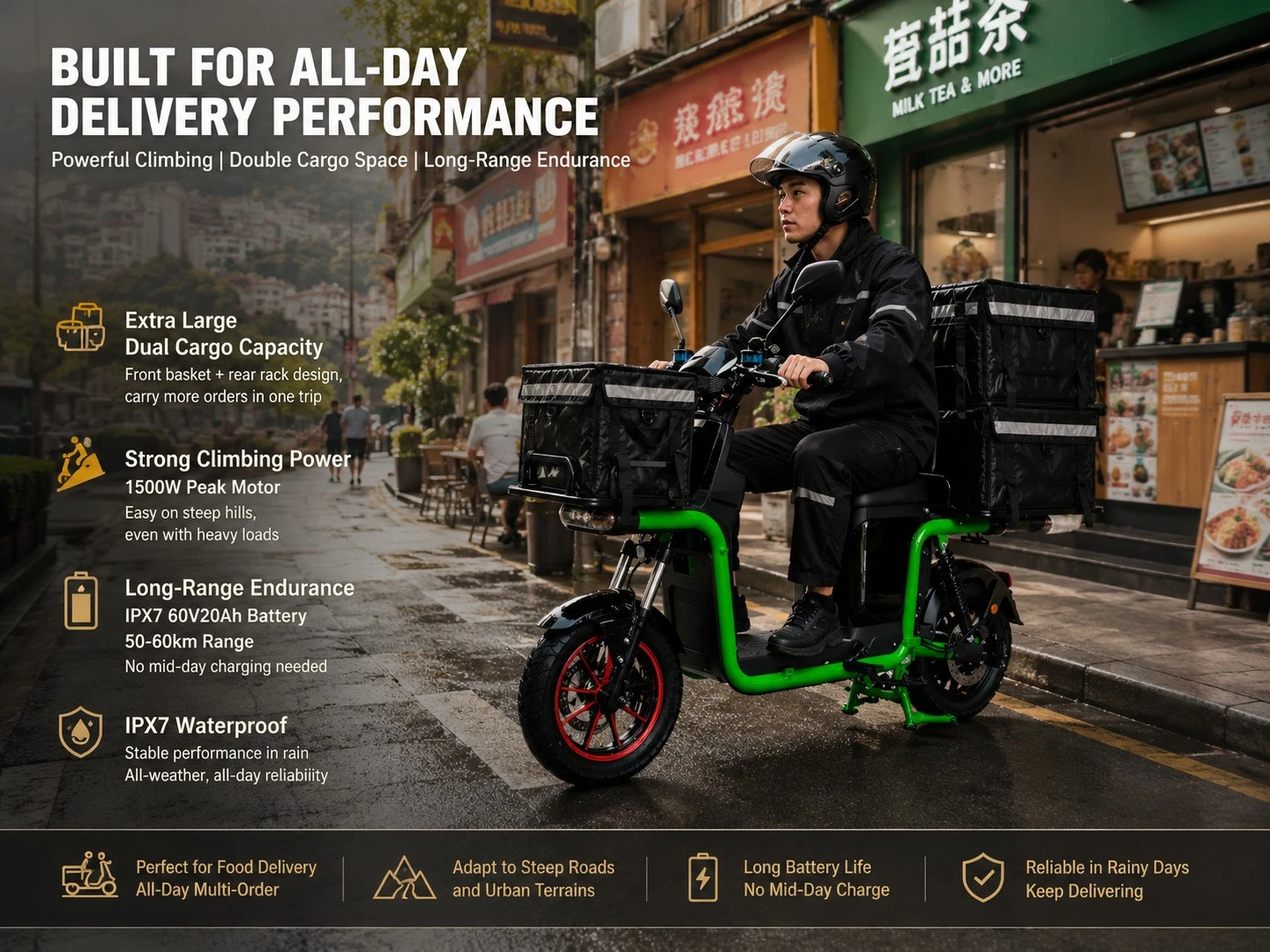
For example, MiLG's Delivery 1500W Heavy Duty Cargo Bike is listed with a 1000W motor and 1500W peak output, a 60V 20Ah lithium battery with optional 60V 30Ah or 72V configurations, a 50–60 km/h top speed, and front and rear cargo baskets. These specifications illustrate how commercial models can be configured differently from everyday commuter vehicles.
Pros of Heavy-Duty E-Motorcycles
- Higher carrying capacity: They are better suited to businesses that transport goods or equipment.
- Stronger construction: Reinforced frames and commercial-grade components can be useful for frequent operation.
- More configuration options: Larger batteries and stronger power systems may support demanding applications.
- Better suited to fleet use: Commercial buyers can select models based on operating hours, payload, and route requirements.
Cons of Heavy-Duty E-Motorcycles
The larger structure and higher specifications can also bring disadvantages.
- Higher purchase cost: More robust components and larger battery systems can increase the initial investment.
- Greater energy demand: A heavier vehicle generally requires more energy to move, although actual consumption also depends on the motor, battery, speed, road conditions, and load.
- Less agile in tight spaces: Larger vehicles may be less convenient on narrow streets or in areas with limited parking.
Lightweight vs. Heavy-Duty E-Motorcycles: Key Differences
| Factor | Lightweight E-Motorcycle | Heavy-Duty E-Motorcycle |
|---|---|---|
| Main use | Urban commuting | Delivery and commercial use |
| Handling | Generally easier | More stable under load |
| Cargo capacity | Usually limited | Usually higher |
| Energy demand | Often lower | Often higher |
| Structure | Compact and lighter | Reinforced for demanding use |
| Operating environment | City streets | Commercial and fleet operations |
| Best buyer | Retailers and commuters | Distributors and fleet buyers |
The right choice depends on the job. A lightweight motorcycle may be more practical for a commuter, while a delivery operator may gain more value from a heavier model with greater carrying capacity.
Which E-Motorcycle Is Right for Your Business?
For Urban Commuting: Choose Lightweight
If your customers mainly travel through busy city streets, a lightweight model can offer easier handling and parking.
This is particularly relevant for markets where customers value convenience more than cargo capacity.
For Delivery: Consider Heavy-Duty
Delivery businesses have different priorities. Vehicles may carry food, parcels, or other goods and operate for extended periods.
In this case, buyers should compare:
- Payload
- Battery capacity
- Motor output
- Brake system
- Suspension
- Daily operating range
For example, MiLG's delivery electric bike range includes models designed around commercial delivery applications. One listed delivery model uses a 500W rear hub motor with optional 350W, 450W, or 800W configurations and removable 48V/60V lithium battery options, showing why buyers should compare specific configurations rather than judge a category by name alone.
For Rental Businesses: Match the Vehicle to the Route
Rental operators should consider how customers will use the vehicle.
For short urban trips, a lighter design may be easier for a wider range of riders. For longer routes or commercial tourism applications, durability and battery capacity may become more important.
For Fleet Operators: Look Beyond Purchase Price
Fleet buyers should calculate the full operating picture.
Consider:
- Daily mileage
- Average payload
- Charging arrangements
- Maintenance requirements
- Spare parts
- Expected service life
- Local compliance
A motorcycle with a lower purchase price is not necessarily the most economical option if it does not match the workload.
How to Choose Between Lightweight and Heavy-Duty Models
A practical purchasing process starts with the application.
Step 1: Define the use case.
Decide whether the vehicle is for commuting, delivery, rental, or commercial transportation.
Step 2: Estimate daily mileage.
Understand how far the vehicle is expected to travel each day.
Step 3: Calculate the payload.
For delivery and cargo applications, estimate the typical and maximum load.
Step 4: Check local regulations.
Certification and registration requirements vary between markets. Our guide to Electric Motorcycle Certifications Required for Different Markets can be used as a starting point, but buyers should confirm current local requirements before ordering.
Step 5: Compare configurations.
Look at motor power, battery capacity, brakes, suspension, and wheel size together.
Step 6: Consider long-term operating costs.
Maintenance, energy use, and parts availability can matter as much as the initial purchase price.
Step 7: Review the supplier.
Evaluate manufacturing experience, documentation, and product range before placing a bulk order.
For more purchasing considerations, see our Electric Motorcycle Wholesale Buying Guide.
What Can Buyers Learn from MiLG's Product Range?
A useful way to evaluate a manufacturer is to look at the range of applications it covers rather than focusing on one model.
MiLG's Electric Motorcycle category includes electric sport, street, and road motorcycles. The company also offers Electric Bikes and Electric Tricycles, giving B2B buyers options across different electric mobility segments.
MiLG's published company information states that it has been involved in electric vehicle sales since 1996 and operates a 30,000㎡ production facility with a stated daily output of 400 units. Its About Us page also lists experience across electric bicycles, scooters, motorcycles, and tricycles. Buyers can review the MiLG company background when evaluating whether its product range fits their sourcing needs.
The key point is not that one manufacturer or one model is suitable for every buyer. Instead, importers should match the manufacturer's actual product range and documented capabilities with their own market requirements.
Lightweight or Heavy-Duty: Which One Should You Choose?
There is no universal winner in the lightweight vs. heavy-duty e-motorcycle comparison.
Choose a Lightweight Model If:
- Urban commuting is the main application
- Easy handling is important
- Customers rarely carry heavy loads
- Compact size is valuable
Choose a Heavy-Duty Model If:
- The motorcycle will carry goods
- Daily commercial use is expected
- Higher payload is required
- The vehicle will operate as part of a delivery or business fleet
The best electric motorcycle is not necessarily the one with the largest battery or most powerful motor. It is the one that matches the actual job.
For importers, the most effective approach is to define the application first, then compare specific models, specifications, certifications, and supplier capabilities. That process makes it easier to build a product range that works for your customers and your business.
Frequently Asked Questions
Are lightweight electric motorcycles better for city commuting?
They can be a good choice because they are generally easier to maneuver, park, and handle in busy urban environments.
Are heavy-duty electric motorcycles better for delivery?
They are often better suited to delivery applications because they can offer greater carrying capacity and stronger structures, depending on the specific model.
Which type has better battery range?
There is no simple answer. Range depends on battery capacity, motor efficiency, vehicle weight, speed, rider or cargo weight, terrain, and riding conditions.
Are heavy-duty electric motorcycles more expensive?
They often have a higher initial cost because they may use stronger frames, larger batteries, or higher-performance components. Actual pricing depends on the configuration and supplier.
How should importers choose between lightweight and heavy-duty models?
Start with the intended application, daily mileage, expected payload, local regulations, and operating costs. Then compare specific models and request detailed specifications before placing a bulk order.


