


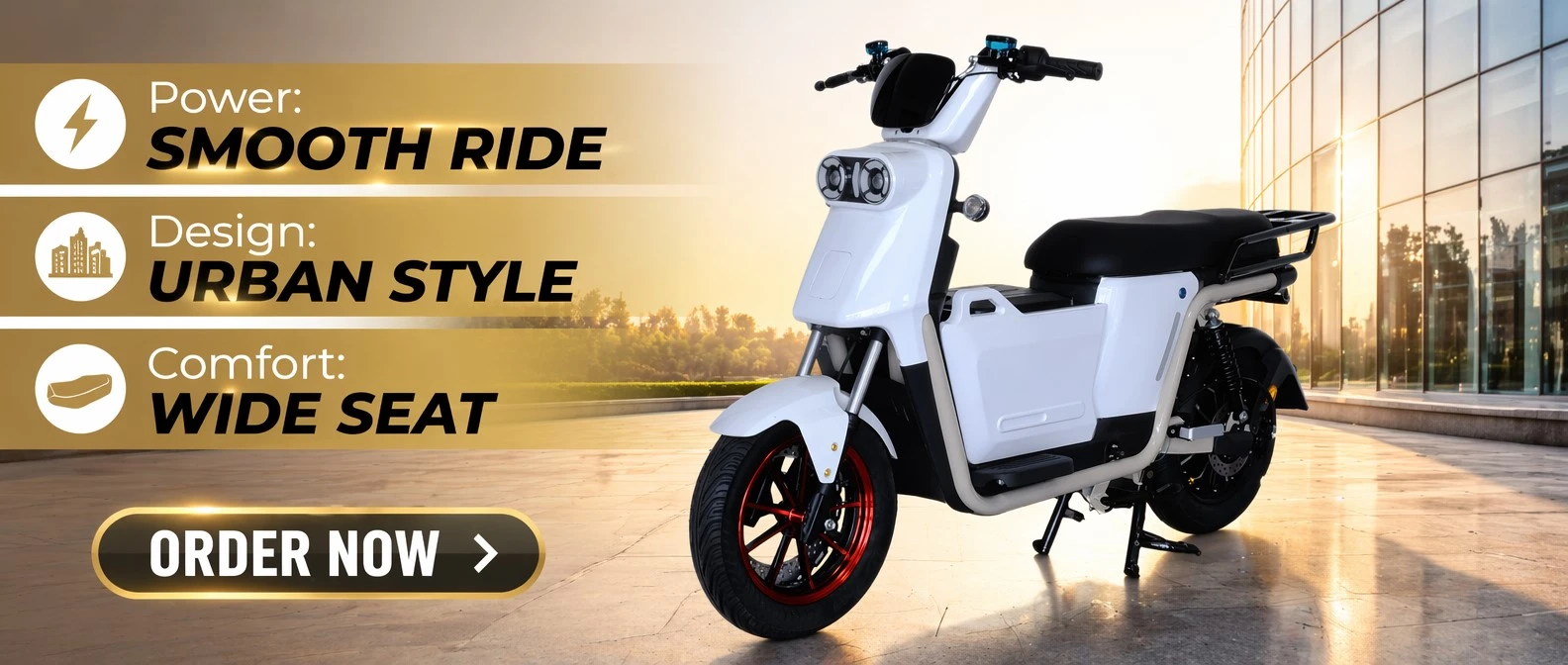
Choosing an e-motorcycle is not simply a matter of picking the highest motor power or longest claimed range. The right model depends on where you ride, how far you travel, how much you carry, and what local regulations allow. For businesses, the decision also involves MOQ, certification, spare parts, and customization.
Whether you are buying one vehicle for commuting or sourcing electric motorcycles in bulk, the best approach is to match the vehicle's specifications to its actual job.
1. Start With Your Main Use Case
Before comparing models, decide how the e-motorcycle will be used.
For daily commuting, comfort, practical range, easy charging, and manageable dimensions are usually more important than maximum power.
For delivery work, battery capacity, load capacity, durability, and cargo accessories become more important. A delivery electric motorcycle may make more sense than a lightweight commuter model because it is designed around frequent commercial use.
For two-person transportation, check the total load, seat length, wheelbase, suspension, and braking system.
For rental or fleet operations, also consider maintenance, spare parts, battery management, and long-term operating costs.
The first question should therefore be: What will this motorcycle actually do every day?
2. Choose Motor Power Based on the Job
Motor wattage is important, but more power does not automatically mean a better motorcycle.
As a general planning reference:
| Motor Power | Typical Use |
|---|---|
| 350–500W | Light urban commuting |
| 500–1000W | General urban riding |
| 1000–1500W | Higher-load urban use |
| 1500–2000W+ | Heavy-duty or performance applications |
These are general reference ranges, not universal legal categories. Local regulations may define vehicles by motor power, speed, vehicle type, or several factors together.
MiLG's published range illustrates how different power levels serve different applications. Its electric motorcycle range includes models from around 400W to 2000W for sport and street applications, while some road models are listed with much higher power configurations.
3. Don't Choose a Battery by Ah Alone
Battery capacity is often shown in amp-hours (Ah), but Ah by itself does not tell you how much energy the battery stores.
A useful calculation is:
Battery energy (Wh) = Voltage (V) × Capacity (Ah)
For example:
60V × 30Ah = 1,800Wh
This gives you a better basis for comparing different battery systems.
Actual range, however, depends on much more than battery size. Rider weight, speed, road conditions, temperature, riding style, and motor efficiency can all affect energy consumption.
For example, MiLG's 1000W 2-seat electric street motorcycle lists 48V/60V/72V 20Ah lead-acid options, an optional 58Ah removable battery, and a reference range of 45–60 km.
The important word is reference. A published range should not be treated as a guaranteed distance under every riding condition.
4. Estimate the Range You Actually Need
Think about your normal daily route rather than the maximum range advertised in a product listing.
For example:
- Short urban trips: around 20–40 km/day
- Regular commuting: around 40–70 km/day
- Commercial delivery: potentially higher, depending on operating hours and daily mileage
These are planning examples, not standardized test results.
If you normally travel 35 km per day, choosing a motorcycle with an extremely large battery may add unnecessary weight and cost. On the other hand, a delivery fleet operating for eight or ten hours needs a very different energy strategy.
For commercial buyers, consider whether batteries can be swapped, charged during breaks, or charged overnight.
5. Check the Total Load Capacity
For two-seat or commercial motorcycles, don't look only at rider weight.
Your actual load is:
Rider + Passenger + Cargo
For example:
- Rider: 75 kg
- Passenger: 65 kg
- Cargo: 20 kg
Total:
160 kg
If the motorcycle's maximum load is 160 kg, you are already at its stated limit.
MiLG publishes models with different load specifications. Its product range, for example, includes a removable-battery model listed with a 150 kg load capacity, while individual models have their own specifications.
Always check the load rating of the exact model and configuration you are buying.
6. Brakes and Suspension Matter More Than Appearance
A motorcycle can look great in product photos and still be unsuitable for your roads.
For braking, you may encounter:
- Front disc + rear drum
- Front and rear disc
- Hydraulic disc systems on higher-performance models
Disc brakes can offer stronger braking performance, but the right system depends on vehicle weight, speed, load, road conditions, and local requirements.
Suspension matters just as much. If your market has uneven roads, potholes, or rough urban surfaces, look closely at the front fork and rear shock absorbers.
For example, MiLG's 1000W X9 model uses a hydraulic front fork, dual hydraulic rear shock absorbers, and 220mm front and rear disc brakes.
Those specifications are more useful to a buyer than simply saying that a motorcycle has a "comfortable suspension system."
7. Match the Tires and Suspension to Your Roads
Your road environment should influence the motorcycle you choose.
Smooth City Roads
A standard street setup may be sufficient for commuting and retail customers.
Uneven Urban Roads
Look for:
- Wider tires
- Appropriate ground clearance
- Hydraulic suspension
- Durable wheels
Mixed or Rough Terrain
You may need stronger suspension, better tire grip, and a chassis designed for more demanding conditions.
MiLG's electric sport motorcycle range includes models using 16×3.0 vacuum tires and front/rear suspension, while its dual-sport model uses a 1000W motor with 16×3.0 tires and a 50–60 km reference range.
The lesson is simple: match the hardware to the road, not the marketing description.
8. Removable or Fixed Battery?
Battery design can have a major impact on daily convenience.
Removable Battery
A removable battery can be useful when riders live in apartments, work in offices, or cannot park close to a charging outlet.
Fixed Battery
A fixed battery can make sense for dedicated parking areas, fleet charging stations, or applications where the vehicle always returns to the same location.
Neither option is automatically better.
The right choice depends on where the vehicle is parked and how it is charged.
If battery swapping is important to your business, check the actual battery weight, replacement process, connector design, and availability of additional battery packs-not just whether the battery is technically removable.
9. Consider Charging Time and Daily Operation
Charging time depends on battery energy, charger output, battery condition, and charging conditions.
A simple estimate is:
Charging time ≈ Battery energy ÷ Charger power
For example:
1.8kWh ÷ 0.3kW ≈ 6 hours
Real charging time may be longer because charging is not always performed at a constant maximum rate.
For a fleet, this becomes a planning issue. Ten motorcycles charging overnight require a different electrical setup from one motorcycle charging at home.
10. Check Local Regulations Before Buying
This step should happen before you select the model.
Different markets may regulate:
- Motor power
- Maximum speed
- Vehicle category
- Braking equipment
- Lighting
- Mirrors
- Turn signals
- Dimensions
- Certification
A model that is legal in one country may require a different configuration-or may not qualify for road use-in another.
Read our guide to electric motorcycle certifications required for different markets before making a purchase decision.
For importers, also confirm that the exact motor, battery, and vehicle configuration is covered by the relevant certification.
11. Look at Total Cost, Not Just Purchase Price
The initial quotation is only the beginning.
Your total cost may include:
Vehicle + Battery + Charger + Shipping + Insurance + Duties + Taxes + Customs + Maintenance
For businesses, add:
- Spare parts
- Warranty costs
- Inventory
- Charging infrastructure
- Local service
A cheaper motorcycle is not necessarily cheaper to operate.
For example, a distributor may save $100 per unit at purchase but spend significantly more later because of higher maintenance or difficult-to-source replacement parts.
This is why total cost of ownership is often a better purchasing metric than factory price alone.
12. Businesses Should Compare Suppliers, Not Just Models
If you are buying 10, 50, or 100+ units, the manufacturer becomes part of the product decision.
Check:
- MOQ
- Production capacity
- Certification
- Model consistency
- Spare parts
- Packaging
- Lead time
- Customization
- Communication
MiLG's published company information states a 30,000㎡ manufacturing facility, a 7,000㎡ production workshop, around 100 employees, and a 3-engineer R&D team. Its website also states a production capacity of 300–500 units per day. These figures provide useful starting points for supplier comparison, but buyers should verify current production arrangements for their specific project.
You can learn more about the company through MiLG's factory and company information.

13. Standard Model, Private Label or OEM?
Your purchasing strategy also affects which motorcycle you should choose.
Standard Model
Best when you want to enter the market quickly with minimal product development.
Private Label
Useful when you want an existing vehicle with your own brand identity.
OEM/ODM
Better suited to businesses that need specific product configurations, branding, accessories, or other market-specific changes.
MiLG publishes OEM and ODM electric motorcycle solutions, while its electric street motorcycle range lists customization options including brand logo, vehicle color, motor power, battery capacity, display system, cargo accessories, and packaging.
However, customization varies by project and model, so confirm the exact scope before placing an order.
14. A Practical E-Motorcycle Selection Checklist
Before buying, answer these questions:
| Question | What to Check |
|---|---|
| Where will it be used? | City, delivery, fleet, off-road |
| How far per day? | Required range |
| How much weight? | Rider + passenger + cargo |
| What speed is legal? | Local regulations |
| Which battery? | Voltage, Ah and Wh |
| What brakes? | Disc or drum |
| What roads? | Tires and suspension |
| Where will it charge? | Removable or fixed battery |
| Buying for business? | MOQ and production |
| Need your own brand? | Private label/OEM/ODM |
| Which certification? | Target market requirements |
This checklist is much more useful than simply asking which motorcycle has the biggest motor or battery.
15. Common Mistakes When Choosing an E-Motorcycle
Choosing Power Before Purpose
A 2000W motorcycle is not automatically better than a 1000W model if your customers mainly need economical urban transportation.
Comparing Batteries Only by Ah
Always consider voltage and total Wh.
Trusting Maximum Range
Real-world range varies with conditions.
Ignoring Total Load
Two passengers plus cargo can quickly change the vehicle requirements.
Forgetting Local Certification
A technically suitable motorcycle may still be unsuitable for legal sale.
Choosing by Appearance
Styling matters to consumers, but brakes, suspension, battery, and parts availability matter to long-term users and businesses.
16. MiLG as One Supplier Example
For buyers comparing Chinese electric motorcycle manufacturers, MiLG can be included in the initial supplier evaluation.
Its published information gives buyers several concrete data points, including its 30,000㎡ facility, 7,000㎡ production workshop, approximately 100 employees, three R&D engineers, and stated 300–500 units/day production capacity.
Its product portfolio also shows different configurations for different use cases. For example, the published X9 model offers a standard 1000W motor, optional 1200W/1500W/2000W motors, 48V/60V/72V battery options, 45–60 km reference range, front and rear 220mm disc brakes, and a 10-unit MOQ.
These are model-specific figures, not specifications that apply to every MiLG motorcycle. Buyers should confirm the current configuration, certification, quotation, and commercial terms for the exact model they need.
17. Which E-Motorcycle Is Right for You?
| Your Need | Prioritize |
|---|---|
| Daily commuting | Comfort + practical range |
| Two-person riding | Load + suspension |
| Delivery | Battery + payload + durability |
| Rental fleet | Reliability + maintenance |
| Urban business | Compliance + operating cost |
| Rough roads | Tires + suspension + clearance |
| New brand | Private label + ODM |
| Established brand | OEM + customization |
The right e-motorcycle is not necessarily the fastest or most powerful model. It is the one whose motor, battery, range, load capacity, braking system, dimensions, and certification match the job.
Conclusion
Choosing an e-motorcycle becomes much easier when you follow a clear order:
Use case → Motor → Battery → Range → Load → Brakes → Suspension → Regulations → Total Cost → Supplier
For individual riders, this approach helps avoid paying for specifications they do not need. For distributors and fleet operators, it provides a more reliable way to compare Chinese suppliers and build a product range.
MiLG is one manufacturer that can be included in that comparison. Its published factory data and model-specific specifications give buyers concrete information to evaluate, while the final decision should always be based on verified specifications, samples, certification, pricing, and the requirements of the target market.
FAQ
How do I choose the right e-motorcycle?
Start with your intended use, daily distance, load, road conditions, local regulations, and charging environment. Then compare motor, battery, braking, suspension, and total cost.
Is a higher-wattage e-motorcycle better?
Not necessarily. Higher power can improve performance but may also increase energy use, cost, and regulatory requirements.
How much battery capacity do I need?
Estimate your daily distance first, then compare battery energy using voltage × Ah. Actual range will vary with speed, load, road conditions, and riding style.
Is a removable battery better?
It is particularly useful when the motorcycle cannot be parked near a charging outlet. For fleet operations, fixed batteries may also work well with dedicated charging infrastructure.
Should I choose disc or drum brakes?
Consider vehicle weight, speed, load, terrain, and local requirements. Higher-performance and heavier motorcycles may benefit from stronger disc-braking configurations.
What should businesses check before buying electric motorcycles wholesale?
Check MOQ, certification, specifications, production capacity, spare parts, lead time, customization, shipping, and total landed cost-not just the unit price.
Can I customize an e-motorcycle for my brand?
Depending on the model and project, customization may include branding, color, motor, battery, display, accessories, and packaging. Confirm the available options with the manufacturer before ordering.


