


For an electric motorcycle, charging is more than a battery specification. Charging speed, charger compatibility, electrical infrastructure, and daily usage all affect the real ownership and operating experience.
For importers, distributors, and fleet operators, the right charging system depends on how the vehicle will be used. A commuter that charges overnight has very different requirements from a delivery motorcycle that may need several charging sessions during a working day.
This guide explains AC vs. DC fast charging for electric motorcycles, including how each system works, the costs involved, and what B2B buyers should check before placing an order.
AC vs. DC Charging: What's the Difference?
The basic difference is where the AC-to-DC conversion takes place.
AC Charging
With AC charging, electricity from the grid enters the vehicle as alternating current. An onboard charger converts it to DC before the battery stores the energy.
Grid → AC charger → Onboard charger → Battery
DC Fast Charging
With DC charging, the charging equipment performs the main AC-to-DC conversion before electricity reaches the motorcycle's battery system.
Grid → DC charging equipment → Battery
This can allow higher charging power, but the motorcycle itself must be designed to accept the relevant DC charging system.
| Factor | AC Charging | DC Fast Charging |
|---|---|---|
| Main conversion | Inside motorcycle | Charging equipment |
| Typical use | Home, workplace, overnight | Commercial and high-utilization use |
| Charging speed | Moderate | Generally faster |
| Infrastructure | Simpler | More demanding |
| Vehicle system | Onboard charger required | DC-compatible architecture |
| Initial infrastructure cost | Usually lower | Usually higher |
The important point is that a fast charger does not automatically make a motorcycle a fast-charging motorcycle. The battery, BMS, charging interface, and vehicle charging system must all support the required power.
How Does AC Charging Work on an Electric Motorcycle?
AC charging is often the simpler solution for everyday electric mobility.
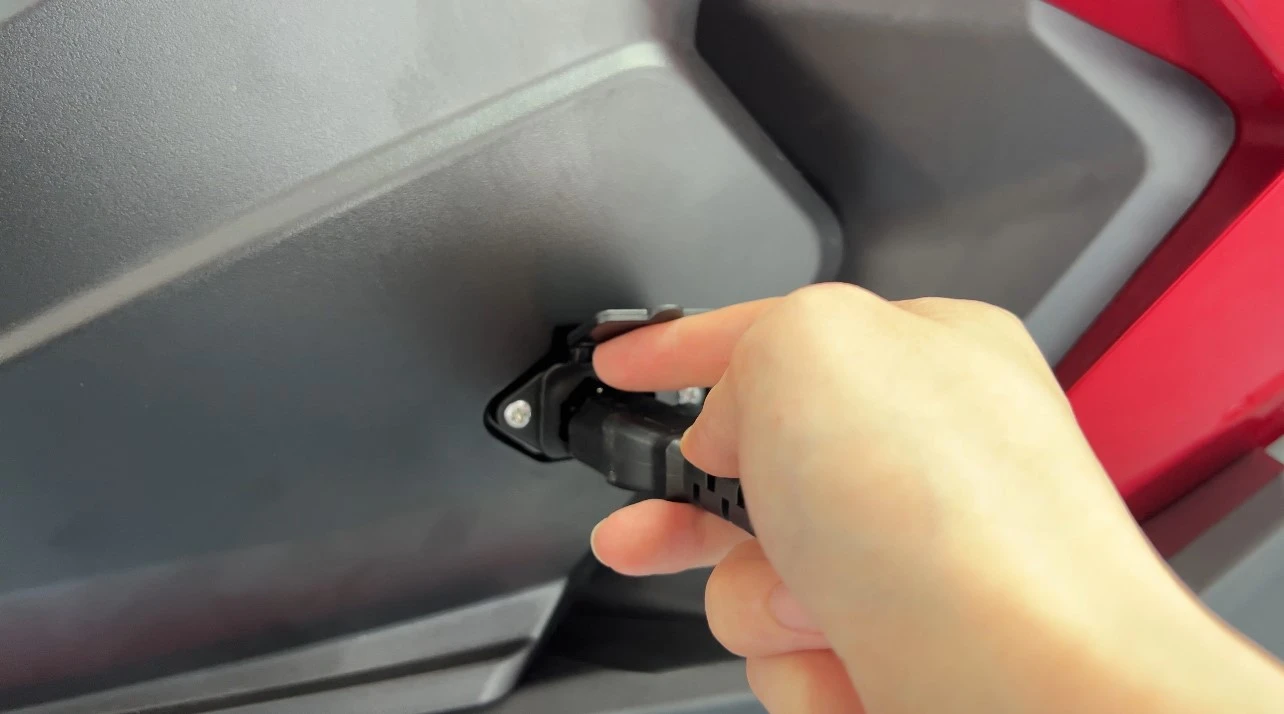
The electricity first reaches the motorcycle's onboard charger. The charger converts AC electricity into DC power suitable for the battery.
The main components include:
- AC input
- Onboard charger
- Battery management system
- Battery pack
- Charging connector
Charging time depends on both battery capacity and charger output.
For example, assume a motorcycle uses a 60V 30Ah battery.
Its nominal energy is approximately:
60V × 30Ah = 1,800Wh = 1.8kWh
If the charger provides approximately 600W, a simple theoretical calculation is:
1.8kWh ÷ 0.6kW = 3 hours
In practice, the actual charging time can be longer because of conversion losses and reduced charging current near the end of the charging cycle.
This is why buyers should compare battery capacity and charger power together, rather than looking at either number alone.
For B2B buyers comparing electric mopeds, the same principle applies: charging time should be checked against the exact battery and charger configuration of the selected model.
How Does DC Fast Charging Work?
DC fast charging moves the main power conversion outside the motorcycle.
The charging station converts grid electricity into controlled DC power and delivers it directly to the vehicle's charging system.
The potential advantages include:
- Higher charging power
- Shorter charging periods
- Less dependence on a conventional onboard AC charger
- Faster vehicle turnaround
This can be particularly relevant to commercial fleets.
However, DC charging requires more than a powerful charging station. The motorcycle must support the charging voltage and current, and its battery management system must be designed to handle the charging process safely.
A 3kW DC charger connected to a motorcycle limited to 1.5kW charging input will not turn that motorcycle into a 3kW fast-charging vehicle.
For procurement teams, the vehicle's maximum charging power is therefore just as important as the charger's rated power.
AC vs. DC Fast Charging: Which Is Better?
There is no universal winner.
AC Charging Is Usually Better When:
- Vehicles charge overnight
- Riders have access to home or workplace electricity
- Daily mileage is moderate
- Charging infrastructure needs to remain simple
- Initial infrastructure cost is important
DC Fast Charging Can Be More Valuable When:
- Vehicles operate for long hours
- Downtime directly affects revenue
- A fleet needs faster turnaround
- Commercial charging infrastructure is available
- Vehicles may require multiple charging sessions per day
For a private commuter, charging from the evening until the next morning may be perfectly adequate.
For a food-delivery fleet, however, a motorcycle sitting unused for several hours can reduce daily productivity. In that situation, charging speed becomes an operational consideration rather than simply a technical specification.
How Fast Can an Electric Motorcycle Charge?
There is no single charging time that applies to every electric motorcycle.
The main variables include:
- Battery capacity
- Charging power
- Maximum vehicle charging power
- Battery state of charge
- BMS charging strategy
- Battery temperature
- Charging efficiency
A useful starting formula is:
Approximate charging time = Battery energy ÷ Charging power
For example:
3.0kWh battery ÷ 1.0kW charging power ≈ 3 hours
This is only a theoretical estimate. Actual charging can take longer.
When comparing suppliers, ask whether the published charging time refers to:
- 0–100%
- 20–80%
- 10–80%
- A specific charger
- A specific battery option
A "2-hour charging time" means little if the supplier does not explain the testing conditions.

Charging Systems for Different Applications
Private Commuting
For daily commuting, AC charging is often practical.
A rider who travels to work during the day can charge the motorcycle at home overnight without needing dedicated fast-charging infrastructure.
Delivery Fleets
Delivery motorcycles have a different operating pattern.
Frequent stops and long operating hours can make faster charging more valuable. For businesses operating electric motorcycles commercially, charging downtime should be included when calculating fleet operating costs.
However, fast charging is not automatically the best option. A fleet that returns to a depot every evening may achieve its operating targets with conventional AC charging.
Rental Fleets
Rental operators need to consider how quickly one motorcycle can be prepared for its next customer.
Here, charging turnaround time and the number of available charging points both matter.
Long-Distance Commercial Use
When motorcycles travel long distances or operate for extended periods, faster charging can reduce downtime between operating cycles.
The final decision should consider actual route length rather than simply choosing the highest charging power available.
AC vs. DC Charging: What About Cost?
The cost of a charging system goes beyond the price of the charger.
AC Charging Costs
Potential costs include:
- Onboard charger
- Charging cable
- Electrical installation
- Protection equipment
- Maintenance
DC Fast Charging Costs
In addition to charging equipment, businesses may need to consider:
- Higher-capacity electrical infrastructure
- Installation
- Electrical protection
- Charging equipment maintenance
- Available site power
- Space requirements
For this reason, the cheapest charger is not necessarily the cheapest charging solution.
A fleet operator should consider:
Vehicle cost + charging infrastructure + installation + electricity + downtime
This gives a more realistic picture of the total cost of operation.
What Should Importers Ask an Electric Motorcycle Manufacturer?
Before ordering a vehicle, procurement teams should request specific charging information.
Battery
Ask for:
- Battery voltage
- Battery capacity
- Battery chemistry
- Nominal energy
- Recommended charging current
Charger
Confirm:
- Input voltage
- Output power
- Output current
- Plug type
- Charging time
Charging System
Ask:
- Is the motorcycle AC or DC compatible?
- What is the maximum charging power?
- What charging interface is used?
- Is the charger included?
- Can the charging system be customized?
Battery Management
Confirm how the BMS manages:
- Over-voltage
- Over-current
- Over-temperature
- Charging protection
These questions can prevent a common purchasing mistake: ordering a motorcycle and charger separately without confirming that the two systems are actually compatible.

How MiLG's Product Range Fits Different Charging Needs
Charging specifications should always be checked model by model. A manufacturer's entire product portfolio should not be assumed to use the same battery or charging configuration.
MiLG publishes individual product specifications for its electric vehicle range. Its portfolio includes electric motorcycles, electric mopeds, electric bikes, and electric tricycles.
For example, published MiLG product specifications include different battery configurations such as 48V, 60V, and 72V, while individual models specify their own charging times and battery capacities. These differences show why buyers should request the complete charging specification for the exact model they intend to import.
MiLG's published company information also states that its facility covers 30,000㎡, including a 7,000㎡ production workshop, with around 100 employees and a three-engineer R&D team. The company states a production capacity of 300–500 units per day.
For buyers evaluating a supplier's broader manufacturing capability, the company's factory and company information provides additional background.
The important point for charging-system procurement is simple: do not assume that every MiLG model has the same charging technology. Confirm the battery, charger, charging power, and charging interface for the specific model and configuration.
Common Charging Mistakes When Buying Electric Motorcycles
1. Looking Only at Battery Capacity
A larger battery does not automatically mean faster charging.
2. Assuming a Fast Charger Makes Any Motorcycle Fast-Charging
The vehicle itself must support the required charging power.
3. Ignoring Local Electrical Infrastructure
A charging system designed for one market may not be suitable for another market's voltage or electrical standards.
4. Comparing Charging Times Without Checking the SOC Range
A stated 20–80% charging time cannot be directly compared with a 0–100% charging time.
5. Ignoring Certification Requirements
Charging equipment and the vehicle may be subject to different requirements depending on the destination.
Before importing, buyers should also review our guide to electric motorcycle certifications for different markets.
How to Choose the Right Charging System
Use this simple checklist.
Choose AC Charging When:
Overnight charging is acceptable
Vehicles have regular parking periods
Infrastructure cost needs to be controlled
Daily utilization is moderate
Consider DC Fast Charging When:
Vehicle uptime is critical
The fleet operates for long hours
Multiple charging cycles may be needed
Suitable electrical infrastructure is available
The key principle is:
Choose the charging system according to vehicle utilization, not simply charging speed.
A high-power charging system may look attractive on a specification sheet, but it provides limited business value if motorcycles already have enough time to charge overnight.
Final Buying Checklist
Before placing an order, confirm:
☐ Battery voltage
☐ Battery capacity
☐ Battery chemistry
☐ Maximum charging power
☐ Charger specification
☐ AC/DC compatibility
☐ Charging connector
☐ BMS configuration
☐ Charging time and SOC range
☐ Local voltage requirements
☐ Local certification
☐ Charging infrastructure cost
☐ Fleet utilization
For buyers planning larger orders, the charging system should be evaluated together with the vehicle's motor, battery, braking system, range, and intended application.
If you are sourcing from China, our guide on how to import electric motorcycles from China can help you evaluate the wider purchasing process.
FAQ
Is AC or DC charging better for electric motorcycles?
Neither is universally better. AC charging is generally practical for overnight and workplace charging, while DC fast charging is more useful when reducing vehicle downtime is a priority.
Is DC charging faster than AC charging?
Generally, yes. However, actual speed depends on the motorcycle's maximum charging power, battery, BMS, charger, and charging infrastructure.
Can every electric motorcycle use DC fast charging?
No. The motorcycle must have a compatible charging architecture, interface, battery system, and BMS.
How long does an electric motorcycle take to charge?
It depends on battery energy and charging power. Actual charging time is normally longer than the simple battery-energy-divided-by-power calculation because of charging losses and charging control.
Is fast charging bad for an electric motorcycle battery?
High-power charging places greater electrical and thermal demands on a battery. Battery chemistry, temperature management, BMS design, and charging strategy all affect long-term performance.
What should importers check before buying a charger?
Check the charger's input voltage, output power, current, connector, charging standard, BMS compatibility, safety protections, and compliance with local electrical requirements.


