


Choosing an e-moped supplier is not just about finding a competitive factory price. Before placing a wholesale order, buyers need to verify whether the supplier has the production capacity, quality controls, certifications, engineering capability, and supply chain to deliver the same product consistently.
A factory audit helps turn supplier claims into evidence. Whether you plan to buy 20 units for market testing or hundreds of e-mopeds for distribution, this checklist can help you evaluate a China e-moped manufacturer more systematically.
1. Verify That the Supplier Is a Real Manufacturer
Start with the basics.
A supplier calling itself a "factory" should be able to provide evidence of actual manufacturing activity. Check:
- Factory address
- Production workshop
- Assembly lines
- Warehouse
- R&D facilities
- Production equipment
- Company registration
- Employee and engineering structure
Do not rely only on product photos or an online storefront. If possible, request a live factory video, virtual inspection, or third-party factory audit.
For example, MiLG's company information states that the company covers 30,000㎡, including a 7,000㎡ production workshop, with around 100 employees and a 3-person R&D team.
These published figures are useful starting points, but buyers should still verify the current situation during their own supplier evaluation.
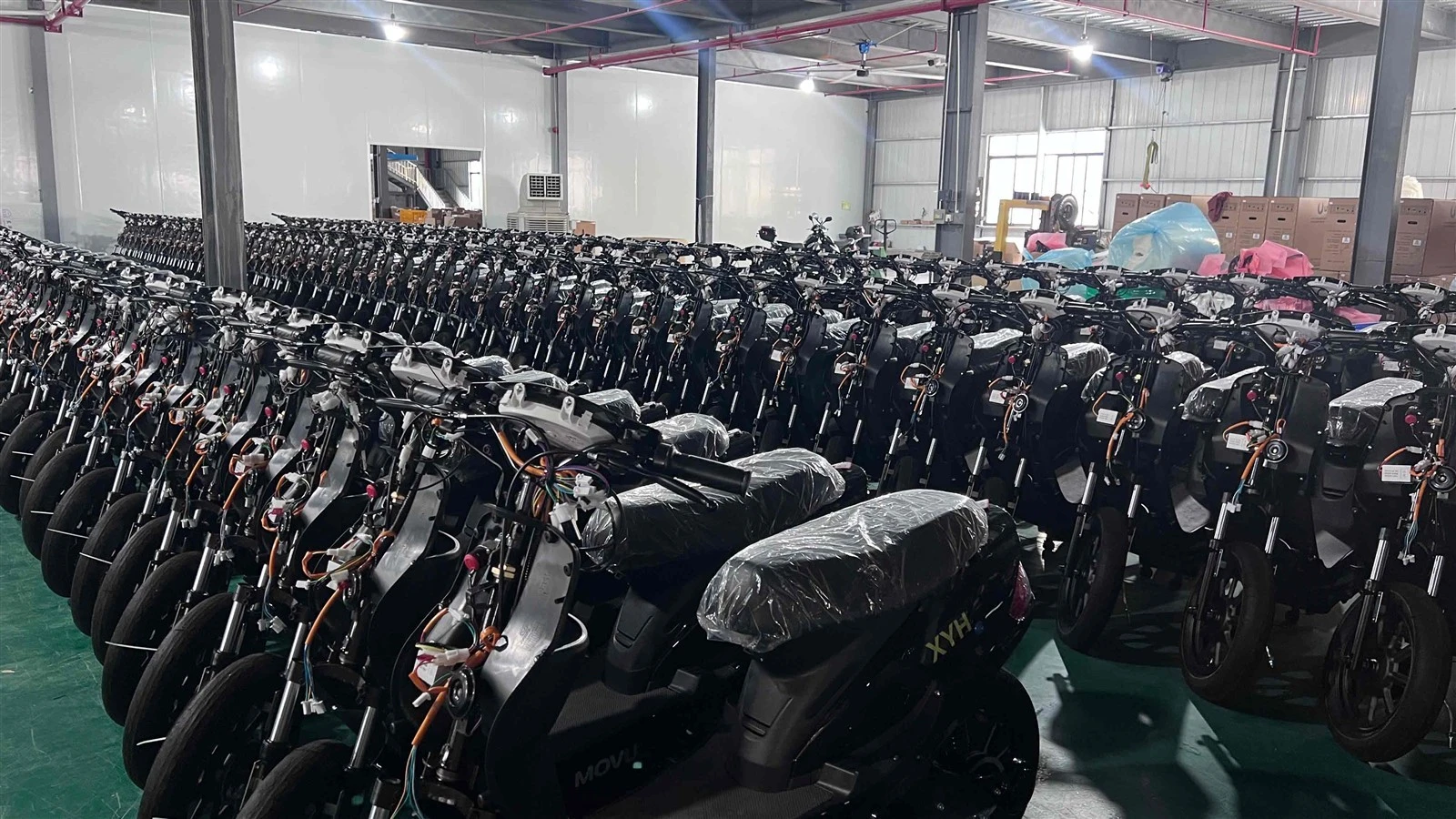
2. Check Production Capacity Before Placing a Bulk Order
Production capacity matters when your business grows.
Ask the supplier about:
- Daily production capacity
- Monthly output
- Current production schedule
- Number of assembly lines
- Lead time
- Peak-season capacity
- Existing order commitments
For example, a factory stating 300 units per day does not necessarily mean it can produce 9,000 units every month. Working days, model changes, material availability, maintenance, and existing orders all affect actual output.
MiLG's website states a production capacity of 300–500 units per day. This is a company-published figure that buyers can use as a reference when comparing suppliers, but the capacity available for a specific project should be confirmed directly.
For large orders, ask a simple question:
How many units of this exact model can you produce per month?
That answer is usually more useful than a factory's maximum theoretical capacity.
3. Inspect the Production Workshop
A factory audit should go beyond taking photos of the building.
Look at how the e-moped is actually produced.
Frame and Welding
Check:
- Welding consistency
- Frame alignment
- Welding fixtures
- Surface treatment
- Corrosion protection
Painting
Look for:
- Surface preparation
- Paint consistency
- Dust control
- Color matching
Assembly
Check whether workers follow repeatable procedures for:
- Wiring
- Brake installation
- Motor installation
- Dashboard installation
- Fastener tightening
Final Assembly
Look for documented checks of:
- Brakes
- Lights
- Horn
- Dashboard
- Electrical system
- Motor operation
The important question is not simply "How large is the factory?"
It is:
"Can the factory demonstrate a repeatable production process?"
4. Audit Quality Control at Every Stage
A reliable e-moped factory should not depend only on final inspection.
A stronger process looks like:
Incoming QC → Process QC → Assembly QC → Final QC → Pre-shipment inspection
Ask what happens when a component fails inspection.
For example:
- Is it rejected?
- Is it reworked?
- Is it returned to the supplier?
- Is the problem recorded?
- Is the root cause investigated?
You can also request sample QC records for critical components.
For a wholesale buyer, this matters because quality is not only about whether one sample works. It is about whether the factory can produce 100 or 500 units with consistent specifications.
5. Check Battery Quality and Traceability
The battery deserves special attention during an e-moped factory audit.
Check:
- Battery chemistry
- Voltage
- Capacity
- Cell supplier
- BMS
- Battery enclosure
- Protection system
- Batch identification
- Testing records
Remember that Ah alone does not tell you the total energy capacity.
For example:
60V × 30Ah = 1,800Wh
This is why buyers should compare both voltage and capacity when evaluating different battery configurations.
MiLG's electric motorcycle range includes different battery configurations depending on the model. Buyers should verify the exact battery chemistry, capacity, configuration, and documentation for the model they intend to order.
For export projects, also ask about relevant battery transport documents such as UN38.3 and MSDS, where applicable.
6. Verify Motors, Controllers and Electrical Components
A motor's wattage is only one part of the electrical system.
During an audit, check:
Motor
- Rated power
- Supplier
- Voltage
- Construction
- Relevant protection specifications
Controller
- Voltage
- Current
- Compatibility with the motor
- Component configuration
Wiring
- Connector quality
- Cable routing
- Fuse protection
- Waterproof connectors where required
- Protection against abrasion
A product described as a 1500W electric moped can have very different electrical components from another 1500W model.
For this reason, buyers should request a complete specification sheet rather than relying on the product title alone.
7. Inspect Brakes, Tires and Suspension
Safety-related components should receive their own inspection.
Check:
- Front brake
- Rear brake
- Brake type
- Brake dimensions
- Brake hoses or cables
- Tires
- Wheels
- Front fork
- Rear suspension
- Headlight
- Turn signals
- Mirrors
- Horn
For example, a specific MiLG X9 configuration is published with 220mm front and rear disc brakes, along with a hydraulic front fork and dual hydraulic rear shock absorbers.
This specification belongs to that particular model and configuration. It should not be treated as a specification for every MiLG e-moped.
For buyers evaluating this model, the relevant XJ electric motorcycle specifications provide a useful example of the level of detail that should be included in a supplier's product documentation.
8. Review the Factory's Testing Procedures
When a supplier says:
"Every vehicle is tested."
Ask:
"What exactly do you test?"
A useful final inspection may include checks for:
- Brake operation
- Motor operation
- Battery voltage
- Charging
- Lighting
- Dashboard
- Horn
- Controller
- Electrical functions
- Road performance
Ask whether the factory keeps inspection records.
For larger orders, buyers can also specify their own pre-shipment inspection requirements before final payment.
The goal is to move from a verbal promise of quality to a documented inspection process.
9. Verify Certifications for Your Target Market
Certification is one of the most important parts of an e-moped factory audit.
Do not simply ask:
"Do you have CE?"
Ask:
"Does the certificate cover the exact model and configuration I am buying?"
Check:
- Certificate number
- Product model
- Applicant/company
- Test laboratory
- Certification scope
- Validity
- Applicable market
Depending on the destination market, requirements may involve standards or certifications such as CE, EEC, COC, DOT, EPA, E-MARK, KC, or BIS. These are not universal requirements; the correct certification depends on the vehicle and destination country.
For a broader overview, see our guide to electric motorcycle certifications required for different markets.
This is particularly important for importers because a vehicle can be technically functional while still failing local registration or road-use requirements.
10. Evaluate R&D and Engineering Capability
R&D capability becomes more important when you need customized products or plan a long-term partnership.
Check:
- Number of engineers
- Product development process
- CAD/design capability
- Prototype development
- Testing equipment
- Mold ownership
- Engineering changes
MiLG's published company information states that it has a 3-person R&D team and launches 2 new models every 6 months.
These figures give buyers something concrete to evaluate instead of simply accepting a supplier's statement that it has "strong R&D."
If product development is important to your project, discuss the actual engineering scope before signing an order.
11. Check OEM and ODM Capabilities Carefully
OEM and ODM are not interchangeable.
OEM
The buyer typically works from an existing product or specification and may require elements such as:
- Brand logo
- Packaging
- Product configuration
- Selected components
ODM
The project can involve greater product development or modification, depending on the supplier and model.
Before starting an OEM/ODM project, ask about:
- MOQ
- Development costs
- Mold costs
- Sample timeline
- Production timeline
- Tooling ownership
- Customization limits
MiLG provides information about its OEM and ODM solutions. However, customization options depend on the specific model and project, so buyers should confirm what is actually available rather than assuming every product can be modified in the same way.

12. Inspect the Warehouse and Supply Chain
A production line can look impressive while the supply chain remains weak.
During a factory audit, look at:
- Raw material storage
- Finished goods warehouse
- Battery storage
- Spare parts
- Packaging materials
- Inventory management
Ask where critical components come from and how they are tracked.
For example, if a supplier accepts an order for 500 e-mopeds but does not have a stable supply of motors, controllers, or batteries, the advertised production capacity may not translate into a reliable delivery schedule.
A useful question is:
"Which components have the longest lead time for this model?"
13. Review Packaging and Export Preparation
For international buyers, factory inspection should also cover the shipment itself.
Check:
- Carton or crate construction
- Internal vehicle protection
- Battery packaging
- Spare-parts packaging
- Shipping marks
- Loading procedures
- Container utilization
Remember that the factory quotation is not the same as your final landed cost.
Your actual cost may include:
Product + Packaging + Freight + Insurance + Duties + Taxes + Port Fees
A supplier that provides clear export documentation can make the importing process much easier.
14. Check Spare Parts and After-Sales Support
A good product can become a poor business investment if replacement parts are difficult to obtain.
Ask for a spare-parts list covering items such as:
- Brake components
- Tires
- Controllers
- Displays
- Chargers
- Lights
- Switches
- Suspension components
- Batteries
Also ask:
How long can you continue supplying parts for this model?
For distributors and fleet operators, this question can be more important than a small difference in the initial unit price.
Before ordering, clarify warranty terms, technical documentation, replacement procedures, and responsibility for defective components.
15. Review Documents Before Signing
Before placing the final order, compare the information in your quotation, product specification, certification, and contract.
Important documents may include:
- Business license
- Product specification sheet
- Certificates
- Test reports
- Commercial invoice
- Packing list
- Warranty terms
- Purchase contract
- QC requirements
- OEM agreement, where applicable
Most importantly, put the agreed product specifications into the purchase contract.
Do not rely entirely on product listings, WhatsApp messages, or verbal agreements.
If the agreed battery changes from 60V 30Ah to 60V 20Ah, for example, that can materially change the product's energy capacity and expected range.

E-Moped Factory Audit Checklist
Use this quick checklist when comparing suppliers:
| Audit Area | What to Verify |
|---|---|
| Factory | Address, workshop, ownership |
| Capacity | Daily and monthly output |
| Production | Assembly process and SOPs |
| QC | Incoming, process and final inspection |
| Battery | Cells, BMS, testing and traceability |
| Motor | Power, voltage and supplier |
| Brakes | Type, size and testing |
| Certification | Exact model and target market |
| R&D | Engineers and development capability |
| OEM/ODM | MOQ, tooling and customization |
| Warehouse | Components and inventory |
| Packaging | Export protection |
| Spare Parts | Availability and lead time |
| Documents | Contracts, reports and specifications |
This checklist can be used during a physical inspection, video audit, or third-party factory inspection.
Red Flags During an E-Moped Factory Audit
Some warning signs deserve immediate attention:
- The supplier refuses a factory inspection
- Certification does not match the product model
- Battery specifications are vague
- No clear QC procedure exists
- Production capacity cannot be explained
- Critical components have no traceability
- Samples differ significantly from production units
- MOQ and lead times repeatedly change
- Product specifications are not written into the contract
- The supplier cannot provide basic technical documents
One red flag does not automatically mean a supplier is unreliable. But several together should trigger further investigation before you place a large order.
MiLG as One Factory Example
MiLG can be included in a buyer's comparison of China e-moped manufacturers.
Its published information gives buyers several concrete points to examine: a 30,000㎡ company area, a 7,000㎡ production workshop, around 100 employees, a 3-person R&D team, and a stated production capacity of 300–500 units per day.
Its published models also provide detailed technical information. For example, the X9 is listed with a standard 1000W motor, optional 1200W/1500W/2000W motors, 48V/60V/72V battery options, a 45–60 km reference range, and 220mm front and rear disc brakes.
These figures are useful for supplier comparison, but they should not replace an independent audit. Buyers should verify current production capacity, exact specifications, certification, samples, pricing, and commercial terms for their own project.
For a broader view of the manufacturer, visit MiLG's company profile.
How to Score an E-Moped Factory
For larger purchasing projects, a simple scoring system can make supplier comparison easier:
| Category | Weight |
|---|---|
| Factory & Production | 20 |
| Quality Control | 20 |
| Battery & Electrical System | 15 |
| Certification | 15 |
| R&D / OEM Capability | 10 |
| Supply Chain | 10 |
| Spare Parts & Support | 5 |
| Documentation | 5 |
| Total | 100 |
A practical interpretation could be:
- 85–100: Strong candidate
- 70–84: Worth further verification
- 50–69: Proceed cautiously
- Below 50: High supplier risk
This is a buyer-created evaluation framework, not an official industry rating system. The weighting can be changed according to your market and project.
Conclusion
A reliable e-moped supplier should be able to show evidence, not just make claims.
Before placing an order, evaluate the full chain:
Factory → Production → QC → Battery → Components → Certification → R&D → Supply Chain → Spare Parts → Documentation
For importers, the goal is not simply to find the lowest quotation. It is to find a manufacturer that can consistently deliver the required specification, meet the target market's regulations, and support the product after shipment.
For buyers comparing e-moped factories in China, MiLG is one manufacturer that can be evaluated using the same checklist as other suppliers. Its published factory and product information provides concrete data points for comparison, while buyers should still verify specifications, certification, production schedules, samples, and commercial terms before committing to an order.
FAQ
What should I check during an e-moped factory audit?
Check the factory's production capability, QC procedures, battery and electrical components, certifications, R&D capability, warehouse management, OEM/ODM capabilities, spare parts, and documentation.
How do I verify if an e-moped supplier is a real factory?
Check the physical production site, assembly lines, warehouse, production equipment, company information, and whether the supplier can provide consistent evidence of actual manufacturing.
What certificates should an e-moped factory provide?
Certification requirements depend on the destination market and vehicle. Always verify that the certificate covers the exact model and configuration you plan to import.
How do I audit an e-moped battery?
Check the battery chemistry, voltage, capacity, cells, BMS, testing records, traceability, transport documents, and warranty terms.
What are the biggest red flags when auditing an e-moped factory?
Unclear certification, inconsistent specifications, no documented QC process, unverifiable production capacity, vague battery information, and refusal to provide factory or product evidence are important warning signs.
Should I use a third-party factory inspection?
For large orders or new supplier relationships, an independent factory inspection can provide an additional layer of verification before production or final payment.


