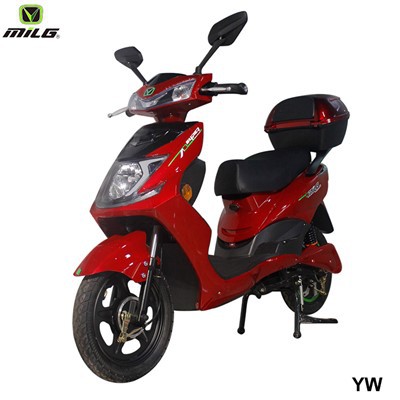
As a supplier of Fat Wheel Scooter Electric, I've witnessed firsthand the incredible technological advancements in these scooters, especially in their battery management systems (BMS). In this blog, I'll delve into how the battery management system works on a Fat Wheel Scooter Electric, exploring its functions, importance, and the benefits it brings to users.
Understanding the Basics of a Battery Management System
A battery management system is an essential component of any electric vehicle, including Fat Wheel Scooter Electric. Its primary function is to monitor, control, and protect the battery pack. In the context of a Fat Wheel Scooter Electric, the BMS plays a crucial role in ensuring the safety, efficiency, and longevity of the battery.
The battery pack in a Fat Wheel Scooter Electric typically consists of multiple lithium-ion cells connected in series or parallel. These cells are sensitive to overcharging, over-discharging, and overheating, which can lead to reduced battery life, performance issues, and even safety hazards. The BMS addresses these concerns by continuously monitoring the battery's state of charge (SOC), state of health (SOH), and temperature.
Monitoring the State of Charge (SOC)
One of the key functions of the BMS is to monitor the state of charge of the battery. The SOC indicates how much energy is remaining in the battery at any given time. This information is crucial for users, as it allows them to plan their rides and avoid running out of power unexpectedly.
The BMS uses a variety of methods to estimate the SOC, including voltage-based, current-based, and impedance-based techniques. Voltage-based methods are the most common, as they are relatively simple and cost-effective. However, they can be less accurate, especially at low SOC levels. Current-based methods, on the other hand, are more accurate but require more complex algorithms and sensors.
Once the BMS has estimated the SOC, it can display this information to the user through a dashboard or a mobile app. This allows users to keep track of their battery's charge level and plan their rides accordingly.
Controlling the Charging Process
Another important function of the BMS is to control the charging process. The BMS ensures that the battery is charged safely and efficiently by regulating the charging current and voltage. It also prevents overcharging, which can damage the battery and reduce its lifespan.
When the battery is being charged, the BMS monitors the battery's voltage and temperature. If the voltage or temperature exceeds a certain threshold, the BMS will reduce the charging current or stop the charging process altogether. This helps to prevent overheating and overcharging, which can cause the battery to degrade or even catch fire.
In addition to controlling the charging current and voltage, the BMS also ensures that the battery is charged evenly. This is important because uneven charging can lead to imbalances in the battery cells, which can reduce the battery's overall performance and lifespan. The BMS uses a technique called cell balancing to ensure that each cell in the battery pack is charged to the same level.
Protecting the Battery from Over-Discharging
Over-discharging is another common problem that can damage the battery and reduce its lifespan. The BMS protects the battery from over-discharging by monitoring the battery's voltage and cutting off the power supply when the voltage drops below a certain threshold.
When the battery's voltage drops below the threshold, the BMS will send a signal to the scooter's motor controller to stop the motor. This prevents the battery from being discharged further, which can cause irreversible damage to the battery cells.
Monitoring the Battery's Temperature
Temperature is another important factor that can affect the performance and lifespan of the battery. The BMS monitors the battery's temperature and takes appropriate measures to ensure that the battery operates within a safe temperature range.
If the battery's temperature exceeds a certain threshold, the BMS will reduce the charging current or stop the charging process altogether. This helps to prevent overheating, which can cause the battery to degrade or even catch fire.
In addition to monitoring the battery's temperature during charging, the BMS also monitors the battery's temperature during operation. If the battery's temperature exceeds a certain threshold, the BMS will reduce the power output of the motor to prevent the battery from overheating.
Benefits of a Battery Management System
The battery management system offers several benefits to users of Fat Wheel Scooter Electric. These benefits include:


- Safety: The BMS helps to prevent overcharging, over-discharging, and overheating, which can cause the battery to degrade or even catch fire. This ensures the safety of the user and the scooter.
- Efficiency: The BMS ensures that the battery is charged and discharged efficiently, which helps to extend the battery's lifespan and improve the scooter's performance.
- Longevity: By protecting the battery from overcharging, over-discharging, and overheating, the BMS helps to extend the battery's lifespan. This reduces the need for frequent battery replacements, which can save users money in the long run.
- Convenience: The BMS provides users with real-time information about the battery's state of charge, state of health, and temperature. This allows users to plan their rides and avoid running out of power unexpectedly.
Conclusion
In conclusion, the battery management system is an essential component of any Fat Wheel Scooter Electric. It plays a crucial role in ensuring the safety, efficiency, and longevity of the battery. By monitoring the battery's state of charge, state of health, and temperature, the BMS helps to prevent overcharging, over-discharging, and overheating, which can cause the battery to degrade or even catch fire.
If you're in the market for a Fat Wheel Scooter Electric, I highly recommend considering a model that comes with a reliable battery management system. At our company, we offer a range of high-quality Fat Wheel Scooter Electric models that are equipped with advanced battery management systems. You can check out our Electric Scooter with Seat Big Wheels, Best Large Wheel Scooter, and Fat Wheel Scooter for Adults for more options.
If you're interested in purchasing our Fat Wheel Scooter Electric or have any questions about our products, please feel free to contact us for a procurement discussion. We look forward to hearing from you!
References
- Battery Management Systems: Design by Modular Approach, by Kai Bussmann, Christian E. Garbe, and Marcus Vogler.
- Lithium-Ion Batteries: Science and Technologies, by Jean-Marie Tarascon and Michel Armand.
- Electric Vehicle Battery Management Systems, by Paul N. Butcher and Andrew J. Colclough.